
 These terrains can sometimes only be traveled by vehicles designed specifically for off-road driving (such as heavy-duty trucks and equipment, SUVs, ATVs, snowmobiles, motorcycles, mountain bicycles) or vehicles that have extra ground clearance, sturdy tires, and in
some cases, front and rear locking differential. Examples of vehicle manufacturers notable for producing types of off-road vehicle (ORV) include AM General, Land Rover,and Jeep,
although most vehicle manufacturers have some sort of off-road vehicle in their current range. These are usually rather expensive cars, but there are exceptions, like the Citroën 2CV, which is actually a budget car (for farmers). Trucks are often fitted with these extras by default. Furthermore, the military usually design their vehicles with off-roading in mind, such as a Jeep or HMMWV, or buy them from off road manufacturers, such as Land Rover, which has produced cars for the armed forces of many countries.


Different uses of the term throughout the world
In some parts of the world, especially in Africa, off-roading is the normal form of transport. In tropical countries, unpaved roads can attain 'off-road' aspects during the rainy season, when extra gears and four wheel drive can become desirable or even necessary. In Western countries the term is frequently used usually more specifically for recreational pursuits.
Types of recreational off-roading
Recreational off-roading is popular among a sub-section of the owners of four wheel drive or all-terrain vehicles and motorcycles. There are numerous categories of off roading, with something suitable for all levels of experience and equipment.
Some of the major categories of recreational off-roading are listed below.
Dune bashing

Dune bashing involves driving over sand dunes, frequently associated with tourism in the Middle-East. There are also many state parks in the United States that allow ORV's to drive on them, including the Silver Lake Sand Dunes in Michigan and the Imperial Sand Dunes in California.
"Greenlaning"

Greenlaning or "Two-tracking" is one of the least 'extreme' categories. It is generally suitable for any four wheel drive vehicle, even with factory tires and equipment. The term greenlane refers to the fact that the routes are predominantly along unpaved tracks, forest tracks, or older roadways that may have fallen into disuse. For a lot of greenlaners, the main emphasis is on enjoying the countryside, and accessing areas that may be seldom traveled by motor vehicles, rather than exploring the performance envelope of their vehicle.
Greenlaning is popular among All Wheel Drive (AWD) SUVs with limited off road capabilities such as the Honda CRV and Toyota RAV4 which were designed for light duty offroading.
Mudding (or Mud Bogging)

Mudding involves finding a large area of wet mud or clay and attempting to drive as far through it as possible without becoming stuck. Usually, the stock tires supplied with four by four vehicles are completely inadequate for this type of off roading, and Mud-terrain tires are required. Strongly attached recovery points are also recommended to enable the vehicle to be towed out if it becomes bogged down. Next to traction, momentum is a big factor in success.
This activity has a competitive form known as Mud bogging.
Rock Crawling

Rock crawling is a highly technical category of off roading. Vehicles are typically modified with larger than stock tires, suspension components that allow greater axle articulation, and changes in the differential (mechanics) gear ratio in order to provide the ideal high torque/low speed operation for rock crawling to traverse obstacles. It is quite common for a rock crawler to have a spotter - an assistant who will go on foot alongside or in front of the vehicle to provide information to the driver on obstacles or areas of terrain that the driver may be unable to see.
Rock Racing
Rock Racing is very similar to Rock crawling in the fact that the vehicles are driven over rocks, the difference is that there are no penalties for hitting cones, backing up or winching as is done in rock crawling. Rock racing also involves a degree of high-speed racing not seen in typical rock crawling.
Formula Off Road

Formula Off Road is a high powered version of off-road competition. Vehicles are highly modified or specially built using sand drag tires and long travel suspension components that allow jumps and rough handling and long axle articulation, highly tuned 8 cylinder (V8) engines with superchargers & nitrous oxide injection systems and a secure roll cage for the driver. High torque/high speed operation is needed for Formula Off Road tracks. Formula Off Road originated in Iceland and has since spread to the other Nordic countries. Competitions are often held in sand and gravel quarries where courses are laid out up near vertical pit faces. The vehicles utilize paddle-like tread of sand drag racing tires.
Trials
Trials are probably the safest form of motorsport. All progress is made at low speed, and the emphasis is on skill rather than finishing first. However, trialling can be highly competitive. There are three traditional forms of off-road trialing.
Road-Taxed Vehicle Trialing
This is the most common form of trialing. As the name suggests, it is for vehicles that are road-legal (and thus required to pay vehicle excise duty. This excludes vehicles that are highly modified or specially-built. However, RTV-class vehicles can carry a wide range of suspension modifications, as well as off-road tyres (provided they are road-legal), recovery winches, raised air intakes etc. Vehicles on RTV trials are usually best described as 'modified from standard'- they use the standard chassis, drivetrain and body that the vehicle was built with. Whilst modification is not necessarily required for an RTV trial, at the very least the vehicle would be expected to have some under-body protection such as a sump guard, differential guard and solid sills. RTV courses are intended to be non-damaging and driven at little more than a walking pace, and a properly-laid out course would be driveable without damage by a skilled driver in a showroom-spec vehicle. However, the terrain usually includes steep slopes, water, side-slopes, deep ruts and other obstacles that could potentially damage a vehicle if mistakes are made or poor driving technique is used, and vehicle modifications increase the chance of success.
Snowmobile

A snowmobile (known locally as snowmachine, snowsled or by the brandname Ski-Doo) is a land vehicle that is commonly propelled by a track or tracks at the rear and steered by skis at the front.
Early snowmobiles used rubber tracks, however a modern snowmobile will have a track made of a kevlar composite. They are designed to be operated on snow and ice, and require no road or trail. Most are typically powered by two-stroke gasoline/petrol internal combustion engines. Four-stroke engines are becoming more and more popular in snowmobiles. Summertime occupations for snowmobile enthusiasts can also involve drag racing on grass, asphalt strips, or even across water. People who ride them commonly are known as snowmobilers. The three main types of riding are Snowcross/racing, trail riding, and mountain climbing.
Motorcycle
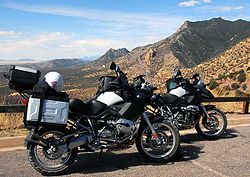
A motorcycle (bike, cycle or motorbike) is a single-track, two-wheeled motor vehicle powered by an engine. Motorcycles vary considerably depending on the task for which they are designed, such as long distance travel, navigating congested urban traffic, cruising, sport and racing, or off-road conditions. In many parts of the world, motorcycles are among the least expensive and most widespread forms of motorised transport.
Sport utility vehicle

A sport utility vehicle (SUV) is a generic marketing description for a rugged automotive vehicle similar to a station wagon but built on a light-truck chassis.[1] Usually equipped with four-wheel drive for on or off road ability, some SUVs include the towing capacity of a pickup truck with the passenger-carrying space of a minivan. SUVs are considered light trucks and often share the same platforms of pickups and thus are regulated less stringently than passenger cars under two major laws in the U.S.—the Energy Policy and Conservation Act for fuel economy standards, and the Clean Air Act for emissions standards[2]
It is known in some countries as an "off-road vehicle" or "four-wheel drive", often abbreviated to "4WD" or "4x4", pronounced "four-by-four". However, not all SUVs have four-wheel drive capabilities. Conversely, not all 4WD passenger vehicles are SUVs. Off-road vehicles are a very different class of vehicles, being vehicles primarily built for off-road use. Although some SUVs have off-road capabilities, this is often a secondary role and they often do not have the ability to switch between 2WD, 4WD high gearing and 4WD low gearing. While automakers frequently tout a particular SUV's off-road prowess with advertising and naming, the daily use of SUVs is largely paved roads and urban areas.
Initially extremely popular in the late 1990s and early 2000s, the SUV's popularity has since declined, due to criticism regarding excessive gasoline consumption, pollution, cost, and poor safety. Due to high oil prices and a declining economy since the mid-2000s, manufacturers have responded to buyers' complaints. The traditional truck-based SUV is gradually being supplanted by a new vehicle type, the crossover SUV, which uses an car platform for lighter weight and better fuel efficiency, but is no longer designed or recommended by the manufacturer for off-road usage or towing.
High Mobility Multipurpose Wheeled Vehicle
- This article refers to the Military HMMWV, not the civilian Hummer sold by General Motors
 | |
| Manufacturer | AM General |
|---|---|
| Production | 1984–present |
| Assembly | Mishawaka, Indiana |
| Successor | None |
| Class | Large SUV |
| Body style(s) | 4-door SUV |
| Engine(s) | 8 Cyl. Diesel 6.2 L (≈378 cu in)[1] |
| Transmission(s) | Turbo-Hydramatic |
| Length | 15 ft (4.6 m) |
| Width | 7 ft (2.1 m) |
| Height | 6 ft (1.8 m), reducible to 4.5 ft (1.4 m) |
| Curb weight | 5,200 lbs (~2340kg) |
| Fuel capacity | 25 U.S. gal (21 imp gal/95 L)[1] |
| Related | Hummer H1 |


The M998 High Mobility Multipurpose Wheeled Vehicle (HMMWV or Humvee) is a military 4WD motor vehicle created by AM General. It has largely supplanted the roles formerly served by the M151 1/4 ton MUTT, the M561 "Gama Goat", their M718A1 and M792 ambulance versions, the CUCV, and other light trucks with the United States military, as well as being used by a number of other countries and organizations.
Features
The HMMWV uses independent suspensions for high ground clearance, and has an axially delivered central tire inflation system. The vehicle also has disk brakes on all 4 wheels, and 4-wheel double-wishbone suspension. The brake disks are not mounted at the wheels as on conventional automobiles, but near the differentials to protect the brake lines.
There are at least 17 variants of the HMMWV in service with the United States armed forces. HMMWV serve as cargo/troop carriers, automatic weapons platforms, ambulances (four litter patients or eight ambulatory patients), M220 TOW missile carriers, M119 howitzer prime movers, M-1097 Avenger Pedestal Mounted Stinger platforms, MRQ-12 direct air support vehicles, S250 shelter carriers, and in other roles. It is capable of fording 2.5 ft (76 cm) normally, or 5 ft (1.5 m) with the deep-water fording kits installed.
Optional equipment includes a winch (maximum load capacity 6000 lb. (2700 kg)), and supplemental armor. The M1025 and M1043/M1044 armament carriers provide mounting and firing capabilities for the MK19 grenade launcher, the M2 heavy machine gun, the M240G/B machine gun and M249 SAW. The newly introduced M1114 "up-armored" HMMWV also features a similar weapons mount. In addition, some M1114 and M1116 up-armored and M1117 Armored Security Vehicle models feature a CROWS (common remotely operated weapon station), which allows the gunner to operate from inside the vehicle, and/or the Boomerang anti-sniper detection system.
History
In the 1970s, the United States Army concluded that the militarized civilian trucks in use no longer satisfied their requirements. In 1977, Lamborghini developed the Cheetah model in attempt to meet the Army contract specifications. In 1979, the Army drafted final specifications for a High Mobility Multipurpose Wheeled Vehicle, or HMMWV. In July of that year, AM General (a subsidiary of American Motors Corporation) began preliminary design work, and less than a year later, the first prototype, the M998, was in testing.
In June 1981, the Army awarded AM General a contract for development of several more prototype vehicles to be delivered to the U.S. government for another series of tests, and the company was later awarded the initial production contract for 55,000 HMMWVs to be delivered in 1985. HMMWVs first saw combat in Operation Just Cause, the US invasion of Panama in 1989.
The HMMWV has become the vehicular backbone of U.S. forces around the world. Over 10,000 were employed by coalition forces during Operation Iraqi Freedom, the 2003 invasion of Iraq.
Usage in combat

The HMMWV was designed primarily for personnel and light cargo transport behind front lines. Like the previous Jeep, the basic HMMWV has no armor or protection against Nuclear-Biologic-Chemical (NBC) threats. Nevertheless, losses were relatively low in conventional operations, such as Desert Storm. Vehicles and crews suffered considerable damage and losses during the Battle of Mogadishu due to the nature of the urban engagement, however, the chassis survivability allowed the majority of those crews to return to safety, though the HMMWV was never designed to offer protection against intense small arms fire, much less machine guns and rocket propelled grenades. However, with the rise of asymmetric warfare and low intensity conflicts, the HMMWV has been pressed into service in urban combat roles it was not originally intended for.
After Somalia, the military recognized a need for a more protected HMMWV and AM General developed the M1114, an armored HMMWV to withstand small arms fire. The M1114 has been in limited production since 1996, seeing limited use in the Balkans before deployment to the Middle East. This design is superior to the M998 with a larger, more powerful turbocharged engine, air conditioning, and a strengthened suspension system. More importantly, it boasts a fully armored passenger area protected by hardened steel and bullet-resistant glass. With the increase in direct attacks and guerrilla warfare in Iraq, AM General has diverted the majority of its manufacturing power to producing these vehicles.


Modifications
In response to the vulnerability of HMMWVs operating in Iraq, "Up-Armor" kits were designed and installed on M998 HMMWVs. These kits, of which there are several types and iterations, include armored doors with bullet-resistant glass, side and rear armor plates, and a ballistic windshield which offer greater protection from ballistic threats and simple IEDs.
Although some of these kits were available prior to the invasion of Iraq, they were not provided in great numbers to American forces in Iraq prior to the invasion. As a result of this, American soldiers and Marines often improvised extra armor with scrap materials, known as "hillbilly armor" to improve the safety of the HMMWV. While this may have made the vehicle somewhat safer from a ballistic attack, it also increased the weight and raised the center of gravity of the vehicle, reducing its acceleration, handling, braking, reliability, and service life due to its overstressed suspension and drivetrain.[2][3]
In December 2004, Secretary of Defense Donald Rumsfeld came under criticism from U.S. soldiers and their families for not providing better-equipped HMMWVs.[4] Rumsfeld pointed out that, prior to the war, armor kits were produced only in small numbers per year. As the role of American forces in Iraq changed from fighting the Iraqi Army to suppressing the guerrilla insurgency, more armor kits were being manufactured, though perhaps not as fast as production facilities were capable of bringing them online. Even more advanced kits were also being developed. However, while these kits are much more effective against all types of attacks, they weigh between 1,500 to 2,200 lbs and have some of the same drawbacks as the improvised armor.[5] Unlike similar-size civilian cargo and tow trucks, which typically have dual rear wheels to reduce sway, the HMMWV has single rear wheels due to its independent rear suspension coupled with the body design.
The armor on most up-armored HMMWVs holds up well against lateral attacks, when the blast is distributed in all different directions, but offers little protection from a mine blast below the truck, such as buried IEDs and land mines. Explosively Formed Penetrators (EFPs) can also defeat the armor kits, causing casualties.
The armor kits fielded include the Armor Survivability Kit (ASK), the FRAG 5, FRAG 6, as well as upgrade kits to the M1151.[6][7] The ASK was the first fielded, in October 2003, adding about 1000lbs to the weight of the vehicle.[8] Armor Holdings fielded an even lighter kit, adding only 750lbs to the vehicle's weight.[9] The Marine Armor Kit (MAK), fielded in January 2005, offers more protection than the M1114, but also increases weight.[10] The FRAG 5, the latest fielded armor kit, offers the greatest protection but may still be inadequate to stop EFP attacks.[11] The FRAG 6 kit, designed to do just that, is still in development, however its increased protection comes at a hefty price. Over 1000lbs is added to the vehicle over the FRAG 5 kit, and the width of the vehicle is increased by 2ft. In addition, the doors may require a mechanical assist device to open and close.[12]
Another drawback of the up-armored HMMWVs occurs during an accident or attack, when the heavily armored doors tend to jam shut, trapping the troops inside.[13] As a result, HMMWVs are being fitted with hooks on their doors, so that another vehicle can rip the door off, freeing the troops inside.[14] In addition, Vehicle Emergency Escape (VEE) windows, developed by BAE Systems are currently being fielded for use on the M1114 uparmored HMMWV, with 1000 kits ordered.[15]
The soldier manning the crew-served weapon on top of the vehicle is extremely vulnerable; however, many HMMWVs have been fitted with basic gun shields, as was the case with M113 APCs after they were first deployed in Vietnam. The U.S. military is currently evaluating a new form of protection, developed by BAE Systems as well as systems designed by the Army, which are already in theater.[16] The new gunner's seat is protected by 1.5 to 2 feet (45.72 - 60.96 cm) high steel plates with bullet-proof glass windows. Additionally, some HMMWVs use CROWS, which slaves the machine gun to controls in the back seat to allow remote operation. The Boomerang anti-sniper system is also being fielded by some HMMWVs in Iraq to immediately give troops the location of insurgents firing on them.

Alternatives
Some have advocated the use of relatively plentiful M113 tracked Vietnam-era armored personnel carriers for combat patrol and convoy escort. Some have been fitted with ACAV modifications for this purpose, as they were employed in Vietnam, which posed similar security problems for convoys.
Other countries in Europe and South Africa employ a number of different light armored vehicles, both tracked and wheeled, and some even built in the US by Cadillac Gage, that are designed more specifically for low intensity combat situations, and are more resistant to small arms; some trucks even have high v-hull bottoms to deflect mine blasts.
In 2007, the US Marine Corps announced an intention to replace all HMMWVs in Iraq with MRAP (Mine Resistant Ambush Protected) armored trucks because of high loss rates, and has issued contracts for the purchase of several thousand of these vehicles, which include the International MaxxPro, the BAE OMC RG-31, the BAE RG-33 and Caiman, and the Force Protection Cougar. [17][18] [19][20][21], which have been deployed with the Army and Marines primarily for mine clearing duties. Heavier models of Infantry Mobility Vehicles (IMV) can also be used for patrol vehicles.[22] Unfortunately, some MRAP vehicles have been known to become stuck or roll over much more readily due to their high center of gravity and overall larger size compared to the HMMWV.
Another weakness has proven to be its size, which has limited its deployment in Afghanistan because it is too large for many forms of air transport. This size also limits the ability for the vehicle to be manhandled out of situations. Additionally, troops in Bosnia found the vehicle's wide track to be a liability, since two Humvees could not pass each other on narrow mountain roads. One vehicle had to drive with two wheels on the unpaved berm, exposing it to land mine danger.

Replacement

The HMMWV replacement process, now being undertaken by the U.S. Military, is an effort to replace the current AM General HMMWV. The HMMWV has evolved several times since its introduction, and is now used in tactical roles for which it was never originally intended. The US Military is currently pursuing several initiatives to replace it, both in the short and long terms. The short term replacement efforts utilize Commercial off-the-shelf vehicles as part of the Mine Resistant Ambush Protected (MRAP) program. Long term efforts include the Joint Light Tactical Vehicle and Future Tactical Truck Systems programs, which are currently focused on building requirements for the HMMWV replacement and technology research and evaluation. Various prototype vehicles such as the MillenWorks Light Utility Vehicle, International FTTS and the ULTRA AP have been constructed as part of these efforts.
Versions


